

By Lyne Pelchat, Executive Director of Regroupement TDL Québec
October is an important month for the Developmental Language Disorder (DLD) community. This year, International DLD Awareness Day will be marked under the theme “Together for DLD”, while the 11th Quebec Developmental Language Disorder Week invites us to go “Beyond prejudice! DLD persists throughout a lifetime”.
Two themes that, to me, fit together perfectly. Because going beyond prejudice starts with understanding one essential thing: Developmental Language Disorder doesn’t go away with age. It doesn’t go away because a child has received services or because speech-language therapy has come to an end.
DLD persists throughout a lifetime.
Its manifestations, its impacts and the person’s needs can, however, change over the years. The challenges experienced in childhood aren’t necessarily the same in adolescence or adulthood. Demands change. Environments change. Studies, work, social relationships, independence and life’s responsibilities can bring new challenges to the surface.
I particularly remember a conversation with a parent that stayed with me. They told me that, throughout their child’s schooling, he had benefited from specialized classes, accommodations and an environment that had learned to take his needs into account. These measures had made a real difference in his daily life.
But when their son left school to enter the job market, the parent quickly realized something: their son was stepping into a whole new jungle.
A jungle where the accommodations he was used to were no longer necessarily there. An environment that was not automatically adapted to his reality.
And that’s where we need to ask ourselves some questions…
Preparing a person to leave the school system isn’t only about helping them earn a diploma or develop professional skills. It’s also about preparing the environments that will welcome them next. The move into the job market shouldn’t be the moment when adaptations disappear and the person suddenly has to learn to function alone in an environment that no longer takes their needs into account.
The end of follow-up services therefore doesn’t mean that the person no longer needs understanding, strategies, adaptations or accommodations.
This is exactly where we must go beyond prejudice!
DLD IS BIGGER THAN LANGUAGE
When we talk about DLD, language is obviously at the heart of the reality. But it doesn’t represent the whole person. And this is precisely where interdisciplinary assessment and follow-up take on their full meaning.
A mother I’ve had the privilege of talking with regularly for several years often tells me about her teenage son’s journey. Over the years, she was told on several occasions that it might be worth having him reassessed. Some even wondered whether what he was experiencing looked more like autism spectrum disorder than Developmental Language Disorder.
Every time doubt crept in, she went back to see the neuropsychologist who had taken part in his assessment. The answer was always the same: her son had undergone an in-depth assessment, carried out over a fifteen-day period by an interdisciplinary team. Several professionals had been able to observe him, analyze his functioning from different angles and pool their expertise before arriving at the diagnosis.
Yes, he had Developmental Language Disorder, but also other particularities and co-occurring conditions that were part of his profile.
His journey struck me because it illustrates something essential: a diagnosis should never be reduced to a single dimension of the person.
I like to use this image: the cognitive function of language is the big flashing red light in a pink ocean. The red draws our attention to DLD and tells us there’s something to understand, something to look at more closely. But around this diagnosis, there may also be other difficulties, other affected functions, other needs and other realities that have a significant impact on the person’s life.
The pink represents everything that lies beyond the DLD diagnosis.
And that’s why the pink ocean must turn blue. We need to be able to look at the whole of the person’s reality, and not only the first signal we identified.
From this perspective, interdisciplinarity isn’t a luxury. It’s essential. Each profession brings complementary expertise: speech-language pathology provides a detailed understanding of language and communication; neuropsychology helps us better understand cognitive functioning, executive functions, attention and memory; occupational therapy makes it possible to observe the impacts on daily functioning. Depending on the needs, expertise in resource teaching, psychology, social work, psychoeducation, medicine, special education and other fields can also shed useful light.
These perspectives don’t compete with one another. They complement one another.
But this approach shouldn’t stop once the diagnosis has been made. It should be able to continue in the environments where the person lives, learns and grows.
And this is where I see a major issue in Quebec: the bridge between the health care system and the school system.
This teenager was eager to learn. He wanted to learn. Yet his schooling was marked by decisions that didn’t always seem to take his actual profile and abilities into account. Because schools are still too poorly equipped to understand the impacts of DLD on learning, and the adjustments and accommodations it requires, he ended up in what I call, with a touch of irony but above all a great deal of sadness, a “touski” class (from the Quebec expression “tout ce qui reste”, meaning “whatever is left over”).
A class that groups together young people with very different realities: intellectual disability, autism spectrum disorder, behavioural disorders and language difficulties, as if having a language challenge could be a sufficient common denominator to determine a student’s educational path.
But DLD isn’t an intellectual disability!
Difficulty understanding and/or expressing language doesn’t mean that the person struggles to understand the world, think, learn or reach their potential. Language and intelligence aren’t one and the same.
If we recognize the importance of an interdisciplinary team to understand a person within the health care system, why should this expertise disappear when they walk through the school door?
The bridge must exist.
The team that helps understand the young person must be able to work with the people who support them every day at school. Teachers and school administrators need the tools to understand how DLD shows up, its impacts on learning and how to learn to do things differently.
And we know it’s possible.
Through my exchanges with the Pôle territorial Le Près Serré in Belgium, I’m discovering a structure that allows interdisciplinary teams, present in different school regions, to support educational settings, equip teachers and help students according to their needs.
This approach shows that it’s possible to build bridges between areas of expertise, schools and the needs of young people.
So I ask myself a very simple question: if it’s possible elsewhere, why couldn’t we do it here?
Quebec has the expertise. We have skilled professionals, teachers who want to do the right thing and families who know their reality. What we too often lack is the bridge that allows these areas of expertise to meet and work in the same direction.
Because DLD is an invisible neurodevelopmental disorder that affects an essential cognitive function: language. Its effects can reach far beyond words themselves and affect learning, executive functions, social relationships, independence and daily functioning, depending on each person’s profile.
A diagnosis can give us a direction. A team can help us understand better. But that understanding then has to make its way to school, to work, to life.
TOGETHER, BUT TOGETHER HOW?
To me, “Together for DLD” means joining forces. Parents know their reality, people with DLD know theirs, teachers know their setting, professionals bring their expertise, practitioners know the field, employers know the realities of their workplace and organizations carry the issues and the needs.
Each of us is a link in the chain. We don’t all need to know the same things. We need to pool what each of us knows and knows how to do.
And to you, parents, families and people with DLD, I want to say it clearly: your voice matters. When we ask you to share your story, take part in research, respond to a consultation or simply tell us about your reality, it’s to move issues forward, make the needs heard and make sure our actions reflect lived reality.
Help us help you. Your link matters!
DLD MUST NOT BE VISIBLE ONLY IN OCTOBER
For 40 years, Regroupement TDL Québec has worked to make the invisible visible, raise awareness, defend rights and advance the understanding of DLD in Quebec. But DLD doesn’t take a break after Quebec DLD Week. It must be visible 365 days a year, 12 months a year.
The child becomes a teenager, then an adult. School gives way to further studies, work, independence and the demands of adult life. The need to understand and adapt doesn’t disappear with the calendar.
That’s why “Together for DLD” can’t be just an October theme. It’s a way of working, thinking and acting, well beyond this awareness period.
IT TAKES A WHOLE COMMUNITY
We often hear that it takes a village to raise a child. I’ve been saying for a long time: it takes a whole community to support a person with DLD.
So the question is simple: What’s your link in this chain?
Because understanding DLD is the beginning. Taking action is what makes the difference. An accommodation, an adaptation, a different way of communicating, taking the time to understand, learning to do things differently: that’s how things change.
Behind every diagnosis, there’s a person. Behind every person, there’s a story. And sometimes, all it takes is listening to that story to better understand what living with DLD really means.
I invite you to listen to this mother tell us, in her own words, about her son’s journey, the challenges they faced and everything that had to be put in place to help him move forward.
Take a few minutes to listen to her. You may come to see DLD differently.
Together for DLD. Not only in October. All year long!
When a young child has language difficulties, parents quickly start asking questions. Is it a phase? Should we see someone? Will a diagnosis be needed? And above all: what can we do right now?
In Quebec, the Agir tôt program aims to intervene as early as possible with children who show signs of developmental difficulties. But access to services and assessments is not the same everywhere. “Agir tôt” (act early) therefore does not always mean being able to act as early as we would like.
Meanwhile, the child keeps growing, playing, learning and communicating.
So why wait to support them better?
WHILE WAITING, THERE IS ALREADY A LOT WE CAN DO
Waiting for an assessment or a diagnosis should never mean putting the child’s development on hold.
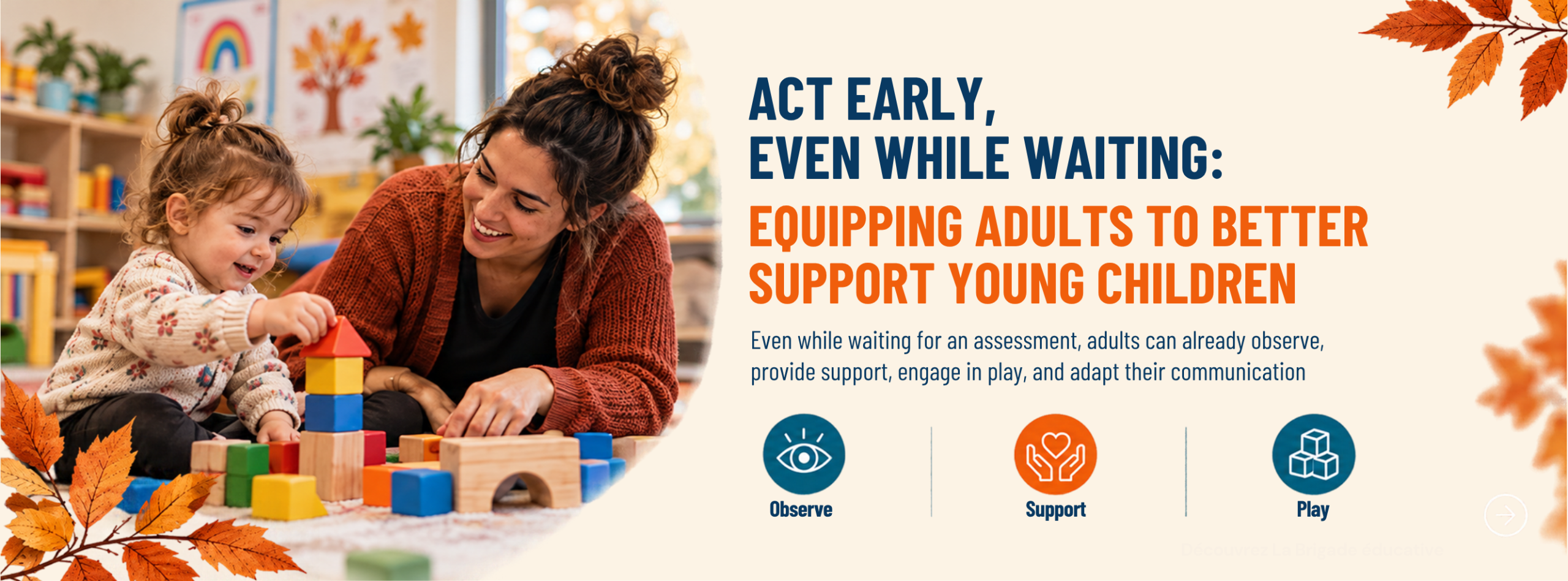
Young children spend a large part of their day in childcare. Early childhood educators and workers are therefore key people: they observe the child in different contexts and see how the child understands, communicates, participates and relates to others. Parents are just as important, since they know their child and may be the first to notice certain difficulties.
So we already have adults around the child who can make a difference. But to act appropriately, they need to be equipped.
Equipping an educator or a parent does not mean making a diagnosis or becoming a speech-language pathologist. It means giving them concrete ways to observe, understand, stimulate and adapt how they interact with the child.
Along the same lines, it is also important to recognize the signs and know what to do when DLD is suspected. We invite you to discover the screening sheet designed by speech-language pathologist Lorianne Lacerte (in French), a practical tool that can help educators better identify signs of DLD and guide next steps. It can help structure observations, document them and share them with parents.
At Regroupement TDL Québec, our guide “Quand consulter en orthophonie 1 à 5 ans” (in French) can also support parents, educators and early childhood workers who have questions about a child’s language development. In particular, it can be given to parents to help them decide whether it would be worth seeking a consultation.
Observe, document, share and refer: that is already a way of taking action.
EQUIPPING CHILDCARE SETTINGS IS ALSO ACTING EARLY
At Regroupement TDL Québec, we believe that tools must reach the very places where children grow and develop.
That is why we work closely with FIPEQ, the federation of early childhood workers in Quebec, to help equip its members to support young children with language difficulties in childcare services and early childhood centres (CPE).
Educators and early childhood workers are with children every day. They are therefore essential partners for observing, supporting and sharing their observations with parents and the other professionals involved with the child.
Because acting early also means giving adults the means to act early.
PLAY: A GATEWAY TO COMMUNICATION
For young children, play is a natural way to discover, experiment, interact and learn. It can also become a wonderful gateway to communication.
For a child with language difficulties, communicating is not just about producing more words. It also means being able to connect, understand, make a choice, ask, show, imitate, express an emotion and take part.
Play makes it possible to work on all of this without turning every moment into an exercise.
This is exactly what appeals to us in the approach of our new partner, La Brigade éducative. Their play-based intervention focuses on the child’s strengths and resources and aims in particular to foster enjoyment, engagement, positive emotions, resilience and social connections.
A child is not a list of difficulties to be corrected.
They have strengths, interests and a personality. When we start from what interests them and what they already do well, we create a favourable context to help them go further.
EQUIPPING ADULTS WITHOUT WAITING FOR A DIAGNOSIS
Stimulating language in early childhood does not replace a professional assessment and does not mean that a DLD diagnosis has already been made.
But between “we don’t know yet” and “there is nothing we can do”, there is a whole space where we can act.
We can comment on what the child is doing, give them time to respond, use gestures or pictures to support understanding, rephrase without constantly correcting, and repeat and build on their initiatives.
Above all, we can create situations where the child wants to communicate.
The goal is not to turn the daycare into a clinic, but to make every moment an opportunity to communicate.
BETTER-EQUIPPED ADULTS, BETTER-UNDERSTOOD CHILDREN
When educators are better equipped, they can also look at certain behaviours differently.
Behind a puzzling behaviour, there may be difficulty understanding, processing or expressing information:
- Does not understand an instruction → may seem not to be listening.
- Searches for words or struggles to express themselves → may seem to lack confidence.
- Cannot explain what they are feeling → may react strongly.
- Has difficulty finding their place in a group game → may seem to prefer playing alone.
Changing how we see things can change how we intervene.
This is also why collaboration between parents and early childhood settings is essential. When observations and strategies are shared, the child benefits from an environment that understands them better.
OUR NEW PARTNER: LA BRIGADE ÉDUCATIVE
It is in this spirit of equipping the adults around young children that we are pleased to welcome La Brigade éducative among our new partners.
Their approach uses play to support children through the small challenges of everyday life, building on their strengths, enjoyment and engagement.
On October 21, as part of Quebec DLD Week, we will be pleased to present their conference (in French):
A great opportunity to come away with concrete ideas to better support young children.
Because a diagnosis can take time.
A child’s development, however, does not wait.
So, while waiting for all the answers, let’s give ourselves the means to act: observe, understand, stimulate, play, communicate and, above all, learn to do things differently.
That, too, is acting early.

One voice can bring a reality to light. One voice can help others understand a need. One voice can change things.
And when these voices are heard together, they can truly move DLD forward!
It takes a whole community to support a person with Developmental Language Disorder.
People living with DLD, parents and loved ones, professionals, researchers, organizations and decision-makers: each brings a different perspective and a part of the reality.
To better understand DLD, have its impacts recognized and meet the needs of the people who live with it, we need data, research, lived experience and, above all, voices.
Because DLD is not experienced the same way at every stage of life. A child’s needs are not those of a teenager, and a teenager’s needs are not those of an adult. The realities of families and loved ones change too.
Moving DLD forward is not the responsibility of a single player. It is a collective responsibility.
And everyone can contribute in their own way.
Your voice can move DLD forward!
RESEARCH: DATA TO MOVE THINGS FORWARD
Research is essential to better understand DLD, how it manifests, its impacts and the most effective ways to support the people who live with it.
It also makes it possible to document a reality that evolves throughout life. The challenges encountered at school, in further studies, at work, in social relationships or in daily life are not the same at every stage.
But we also have to say it clearly: data and statistics are essential to move issues forward.
Decision-makers need to be able to rely on data to understand the scope of a reality, measure needs and make decisions. When it comes to developing services, adapting programs or better meeting a population’s needs, evidence carries significant weight.
Research therefore helps us better understand DLD, but it also gives us arguments to show what needs to change.
Research is answering the call. Researchers are increasingly interested in DLD, and collaborations are growing in Quebec, across Canada and with other countries.
In Quebec, several research projects we are collaborating on are currently under way, and some need participants. Each of these projects is an opportunity to contribute concretely to advancing knowledge about DLD and about the realities experienced by the people concerned and their loved ones.
Participation can take many forms:
- Do you have DLD? Your first-hand experience, your daily life, your challenges and your strategies are essential to better understand this reality.
- Are you a parent? Your experience and observations bring an essential perspective on the impacts of DLD on family, school and social life.
- Are you a loved one or family member? Your perspective also helps us better understand realities that are not always visible from the outside.
It is never too late to do your part. Answering a survey, taking part in an interview or participating in a study may seem like a small contribution. Yet every contribution helps to better document a reality that is still too little known.
MAKING THE REALITY OF DLD HEARD BY DECISION-MAKERS
Data show the scope of the issues. Lived experiences help people understand them concretely.
When we bring DLD to decision-makers, we must be able to answer very concrete questions:
- What does a family go through when it waits months, or even years, for services?
- What impact can this wait have on the child, and also on the parents?
- What happens when a young person arrives at school with a diagnosis, but the necessary adaptations are not put in place?
- What obstacles does a teenager face when making school choices while their profile and needs are poorly understood?
- What does an adult go through when dealing with the demands of work without their DLD being recognized or understood?
- Which adaptations can truly make a difference in their daily life?
Data give weight to the issues. Lived experiences give them a face.
VOICES FROM ACROSS QUEBEC
Over the summer, we reached out to the public to build a list of people who would agree to be contacted when an opportunity to share their story comes up.
This call remains open.
We are still looking for people with DLD, parents and loved ones from every corner of Quebec who would agree, depending on their availability, to share their experience.
These testimonials may be requested in different contexts:
- an interview for print media;
- a radio or television interview;
- an online article or web report;
- a consultation or an awareness initiative.
Why is this important?
Because when we talk about the reality of DLD in Quebec, we need to be able to show that it is not limited to a single region.
The reality of a family in Montérégie may be different from that of a family in Abitibi, Saguenay–Lac-Saint-Jean, Gaspésie, the Capitale-Nationale or elsewhere in Quebec.
To carry these issues at the provincial level, we need a picture that reflects this diversity.
We want to hear voices from all over Quebec.
If you would like to be part of this list of people who may be contacted, please send us your contact information at info@regroupementtdl.ca
You will always remain free to accept or decline a request. We will contact you when an opportunity matching your profile comes up.
EVERYONE CAN CONTRIBUTE IN THEIR OWN WAY
Moving DLD forward does not necessarily mean committing for several years. The organizations working on the ground for DLD and the Regroupement need people willing to contribute, according to their means.
This can mean:
- taking part in research;
- sitting on a board of directors;
- taking part in a committee or a consultation;
- sharing professional expertise;
- taking part in an activity or a campaign;
- sharing your experience;
- responding to a one-time request.
Sometimes, a few minutes of your time helps gather important information. Sometimes, expertise moves a file forward. Sometimes, a testimonial makes visible a reality that would otherwise remain invisible.
You don’t have to do everything. Sometimes it is enough to do your part, at the right time.
DLD affects children, teenagers, adults and families all across Quebec. To move things forward, this diversity must be heard, documented and represented.
What role can you play, in your own way, to move DLD forward?
Your voice can help document a reality, help others understand a need, support a request or change a decision.
Your voice can move DLD forward!
For a person with Developmental Language Disorder (DLD), the path to the world of work can begin long before the search for a first job. It is prepared during adolescence, continues through the transition from school to active life and evolves throughout adulthood.
TSAL, internships, independence tools and job-readiness programs can help young people develop their strategies and better understand their strengths. But once they are at work, their needs do not disappear. They may simply take other forms.
For adults with DLD, challenges may involve understanding instructions, processing information, organization, communication, shifting priorities or how they demonstrate their skills. And many adults have never received a diagnosis.
DLD does not define a person’s skills. It can, however, influence how they access information, process it and carry out certain tasks.
From a first career plan to keeping a job, how can we better prepare, guide and support people with DLD in the world of work?
PREPARING THE TRANSITION TO THE WORLD OF WORK
For teenagers, preparation for active life begins long before the end of their studies. TSAL, the Transition from School to Active Life (TÉVA in French), plays an important role in this process. It should be offered in every school and, above all, be adapted to the realities of teenagers with DLD.
Preparing a young person for employment is not only about discussing careers or looking for an internship. It also means helping them better understand their strengths and needs, develop strategies and prepare for situations that may require more effort: understanding verbal instructions, processing several pieces of information at once, organizing tasks, adapting to change, asking for clarification or explaining what can help them succeed.
The ESCALADE program fits precisely into this approach. Designed for teenagers with DLD, it offers classroom activities that work on self-knowledge, communication skills, socialization, and planning and organization. These skills are not only useful at school. They are also important for the transition to adult life and the world of work.
Independence does not mean doing everything alone. It also means knowing how to recognize your needs, use the right tools, rely on your strengths and ask for support when needed.
Tools such as the Je quitte le nid program, currently supported by some organizations and practitioners who work with people with DLD, can also help develop this independence. They make it possible to address different aspects of adult life in a concrete way.
But these tools and opportunities should not depend on where the young person lives or on the resources available around them.
LEARNING BY DOING
Moving from theory to reality is just as important. Internships and work experiences allow young people to discover the demands of a job first-hand, try out their strengths, develop strategies and better understand what suits them.
Programs such as J’y Vais can also support this transition by giving young people the chance to become familiar with the world of work.
These opportunities must be accessible everywhere in Quebec. A young person with DLD should not have fewer opportunities to prepare for employment simply because they attend a school or live in a region where resources are scarcer.
AND WHAT ABOUT ADULTS WHO ARE ALREADY WORKING?
The transition to employment is only one step. For many adults with DLD, the challenge now is to stay employed, advance in their workplace and have their skills recognized.
But not all adults who live with the impacts of DLD have necessarily received a diagnosis along the way.
Some were identified at another time, when terms such as “dysphasia” or “primary language disorder” were used. Others have never received a diagnosis and have learned, over the years, to cope with their difficulties by developing their own strategies. Some have even adapted their educational or career path without ever understanding why certain situations required so much effort.
Even today, an adult can therefore live with the impacts of DLD without it ever having been clearly identified. And the absence of a diagnosis does not mean the absence of needs.
Once at work, the demands do not disappear. They change.
Understanding verbal instructions, processing several pieces of information at the same time, taking part in meetings, reading complex documents, managing emails, setting priorities, planning a day or adapting quickly to a change can all be significant challenges.
And because DLD is invisible, some difficulties can be misinterpreted. A person may be perceived as inattentive, disorganized, lacking independence or less competent, when the problem actually lies in how information is conveyed to them or in the time they need to process it.
DLD does not define a person’s skills. But it can influence how they access information, process it and demonstrate what they can do.
Simple adjustments can make a real difference: giving instructions in writing, structuring information, checking for understanding, using organizational tools, reducing distractions or allowing a little more time to process certain information.
WHAT IF THE PERSON DOESN’T EVEN KNOW THEY HAVE DLD?
This is a reality we must also consider.
When an adult has never received a diagnosis, they have often spent years compensating, developing strategies and finding their own ways of doing things. The absence of a diagnosis does not mean the absence of needs.
Employment resources must therefore be able to recognize the possible impacts of DLD, even when it was not identified in childhood or adolescence.
RESOURCES FOR THE PERSON AND FOR THE EMPLOYER
Specialized resources exist to support job searching, integration and job retention, for both individuals and employers. ROSEPH, the Regroupement des organismes spécialisés pour l’emploi des personnes handicapées (Quebec’s network of specialized employment services for people with disabilities), is an important player in this support. Its member organizations offer services that can support people on their path to employment, as well as employers in their efforts to integrate and retain employees.
It is not enough to tell a person to find a job. We need to be able to help them identify their strengths, target an environment that suits them, prepare for an interview, understand the requirements of the position and develop strategies to succeed in it.
In the same way, it is not enough to ask an employer to be inclusive. We need to give them access to the knowledge, tools and resources that will allow them to support the person well.
That is precisely why the links between specialized employment resources, the organizations that support people with DLD and employers are so important. Everyone needs the right tools so that the person can not only access employment, but also stay in it and fully demonstrate their skills.
WORKING DIFFERENTLY, BUT WITH THE SAME GOALS
This is where the testimonial of Maxime Proulx takes on its full meaning.
A person with DLD can work, be competent, take on responsibilities and contribute fully to their workplace.
They may simply go about it differently…
This is an important distinction. Because in the workplace, are we really attached to having the work done the traditional way, or to achieving the expected result?
If a person finds another way to get organized, process information, plan their work or complete a task, is that necessarily a problem if the work is well done?
The result is what counts. The way to get there can be different.
That, too, is inclusion: not confusing “doing things differently” with “being less capable”.
People with DLD are not asking for requirements to disappear. They need others to understand that certain strategies, tools or ways of doing things can allow them to fully demonstrate their skills.
PRACTITIONERS WHO NEED TO BE BETTER EQUIPPED
At Regroupement TDL Québec, we see that the practitioners who support young people and adults toward employment are not always trained on DLD and its impacts.
Yet we are talking about a reality that affects more than 1 in 14 people!
This means there are many young people preparing to enter the job market, and many adults who are already there.
How can we offer appropriate support if we do not know enough about the reality of the person we are supporting?
Resources must therefore be more comprehensive, and practitioners better equipped to understand DLD, recognize its impacts and know the strategies that can make integration and job retention easier.
BUILDING THE BRIDGE, FOR REAL!
The move from school to the world of work cannot be a series of breaks.
We need a true continuum between the Ministère de l’Éducation, the Ministère de l’Emploi et de la Solidarité sociale, schools, specialized employment resources and businesses.
TSAL must prepare young people for the reality of active life. ESCALADE can help develop essential skills. Internships and programs such as J’y Vais must make it possible to experience the world of work first-hand. Tools such as Je quitte le nid can support the development of independence. Then, in adulthood, specialized resources must be able to support the person and assist employers.
But this continuum will only be effective if resources are sufficiently developed and if the practitioners who support people truly understand DLD and its impacts.
A person with DLD can work, succeed and contribute fully. They may simply need to do things differently!
And what if real change started with this question: what do we really expect from a person at work, their way of doing things or the result they can achieve?
Getting organized. Staying focused. Remembering an instruction. Managing an emotion. Adapting to a change. Starting a task… and above all, finishing it!
These skills are part of our daily lives. For some people with Developmental Language Disorder (DLD), they can be an additional challenge.
So how can we support them concretely?
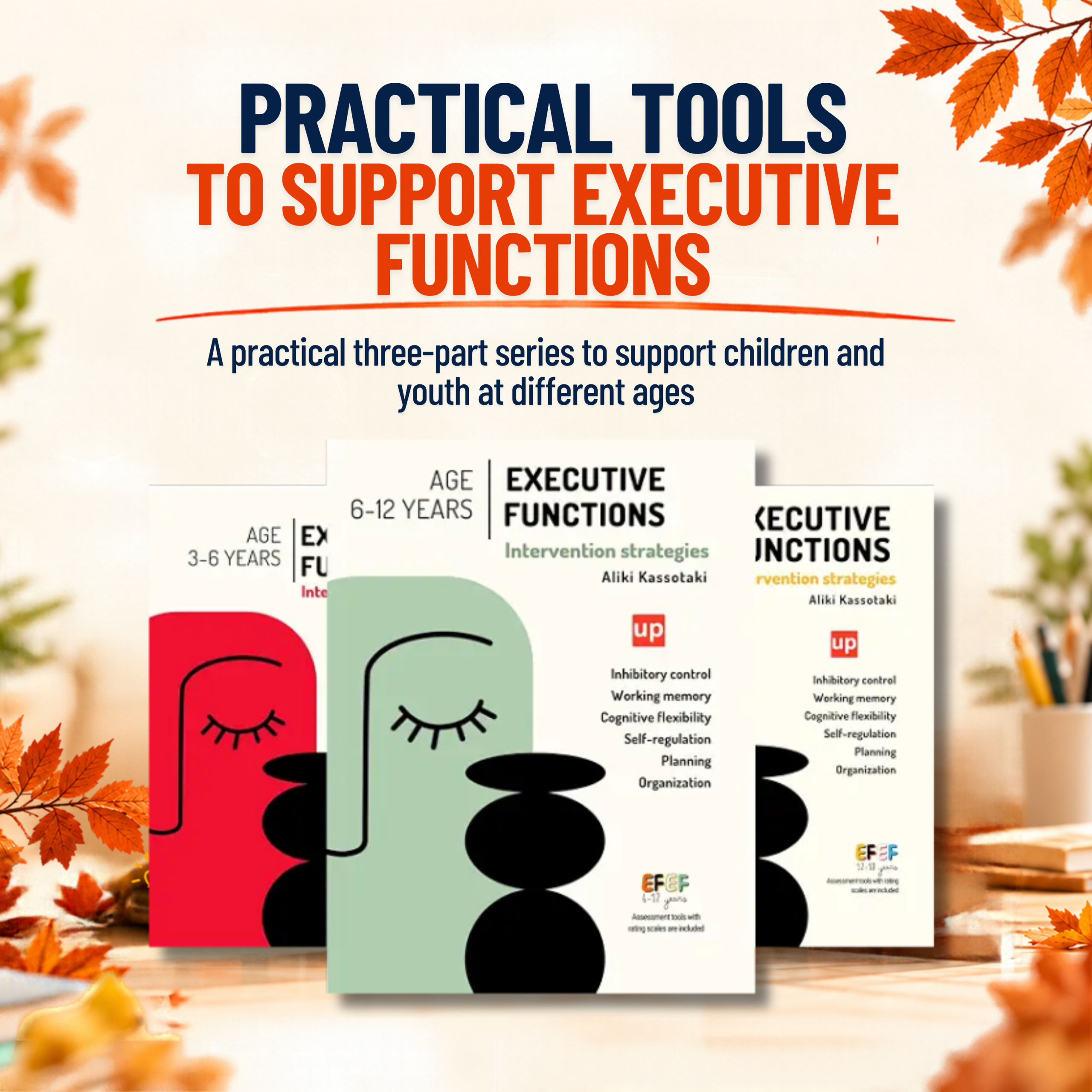
We invite you to discover a series of three books on executive functions, designed to support young people according to their age: 3–6 years, 6–12 years and 12–18 years.
Each book offers concrete strategies, hands-on activities and ready-to-use materials to work on different executive functions, including self-regulation, working memory, cognitive flexibility, inhibition, planning and organization.
The goal? To move from theory to action and have tools at hand that can easily fit into everyday life.
Parents, teachers, practitioners or professionals: you will find ideas to help young people better understand their challenges, develop their strategies and gradually become more independent.
And why choose just one book? One book suited to the young person’s age… or all three to follow the development of executive functions through the different stages of growth!
👉 Discover the series and find the tools that meet your needs.
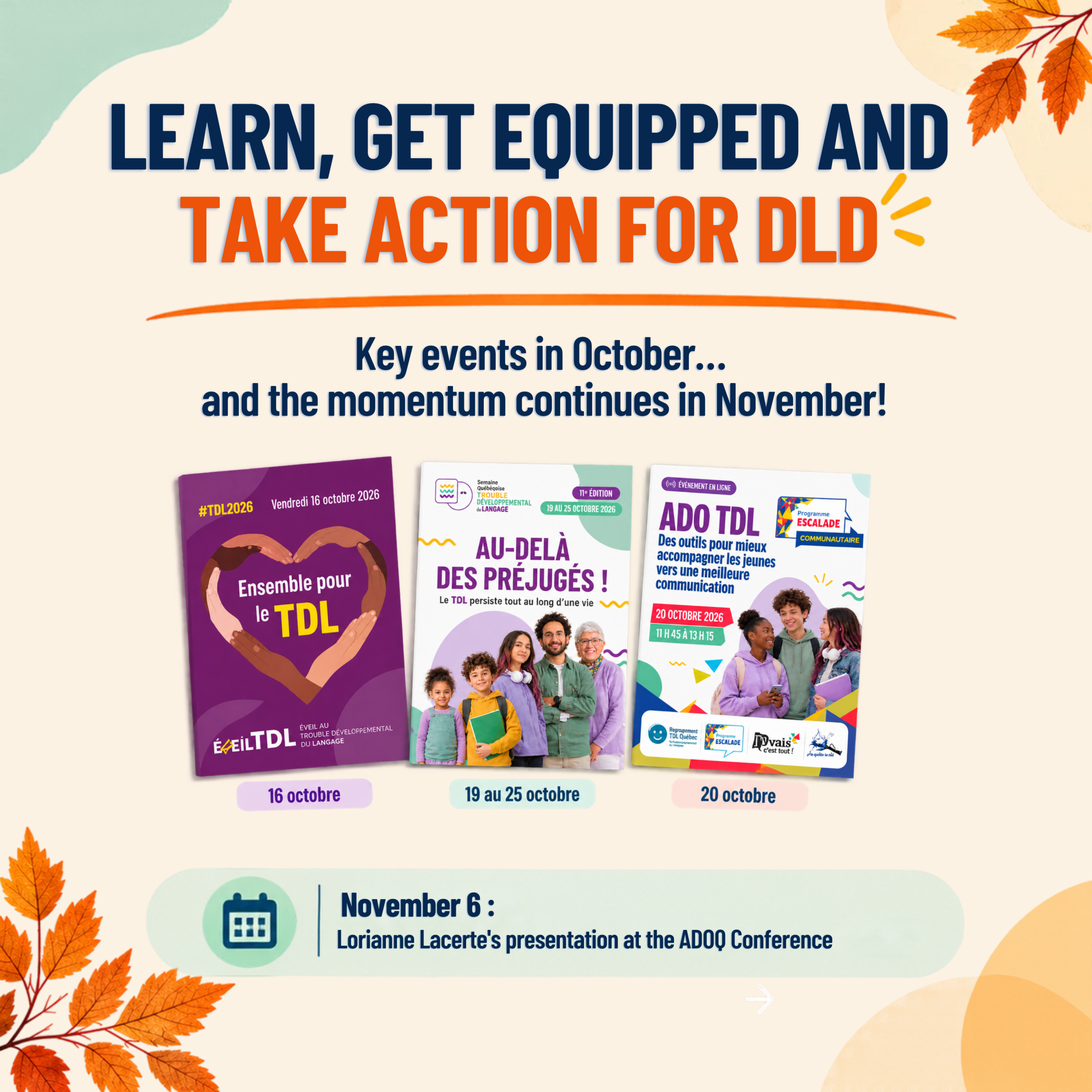
October will be full of opportunities to shine a light on Developmental Language Disorder (DLD)!
It all begins on October 16 with International DLD Awareness Day, under the theme “Together for DLD”. More than 40 countries will mobilize to make DLD visible through a range of initiatives, including light-ups, displays and awareness activities.
From October 19 to 25, it will be time for the 11th Quebec DLD Week, under the theme “Beyond prejudice! DLD persists throughout a lifetime”.
Many activities, training sessions and workshops will be offered during the week. To discover the full program, check out our events calendar and our social media. You will find opportunities to learn and get equipped, whether you are a parent, a professional or a practitioner.
And we will keep the momentum going in November!
On November 6, our partner Lorianne Lacerte, speech-language pathologist, will present the conference “Quand les diagnostics masquent le trouble développemental du langage” (in French) as part of the 37th conference of the ADOQ (Association des orthopédagogues du Québec), to help better equip professionals in Quebec.
We will also mark Quebec Disability Employment Awareness Week.
DLD deserves to be visible, understood and better supported all year long. It is up to us to keep the movement going!