

By Lyne Pelchat, Executive Director of Regroupement TDL Québec
Does Developmental Language Disorder (DLD) go beyond language difficulties? It is a question that deserves our full attention.
For some people living with DLD, the challenges are not limited to understanding or expressing themselves. Difficulties with working memory, organization, planning or emotional regulation can also make daily life harder. Yet these realities are not always recognized or explained to families.
Since I joined Regroupement TDL Québec, my conversations with parents of children, teenagers and adults living with DLD have fuelled a growing concern: do we sufficiently understand what lies beyond language?
Language remains at the heart of DLD. This is essential to remember. But I also see it as a red warning light: it catches our attention and tells us that we need to try to understand what is going on.
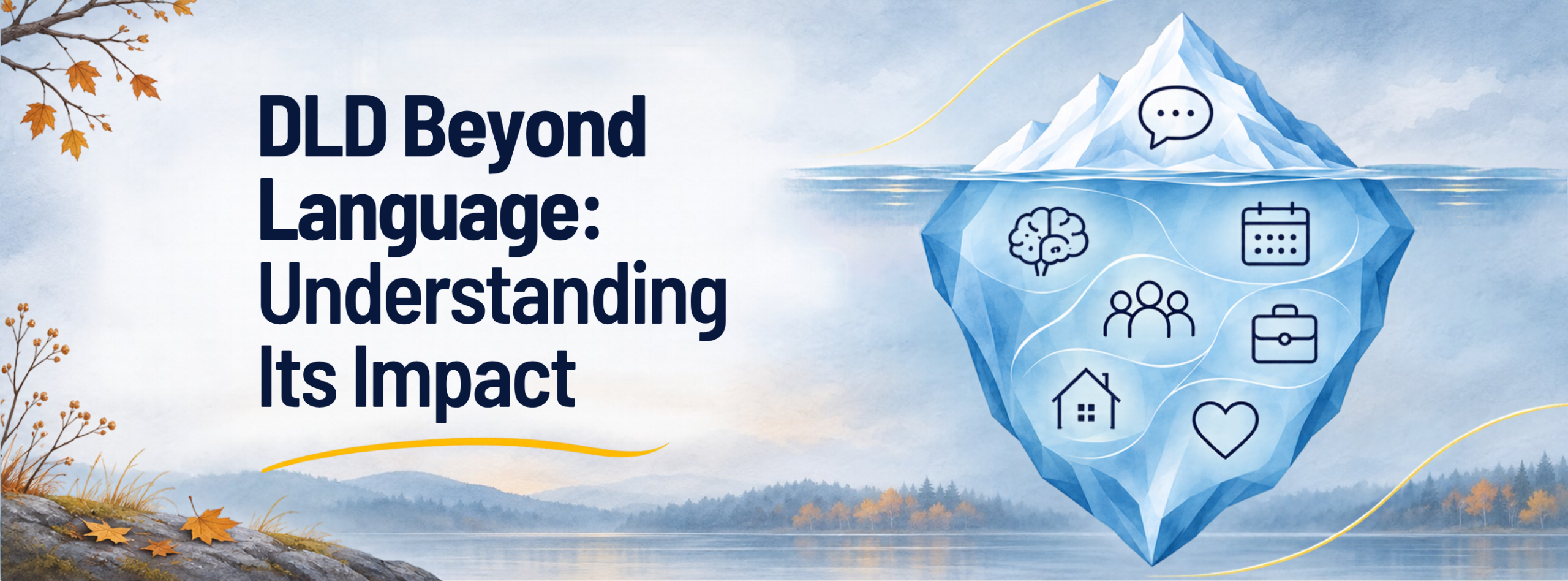
The image of the iceberg illustrates this reflection well. What we see above the surface is only part of the reality. Other difficulties can remain invisible, sometimes for years.
If we stop at what we can see, how can we hope to understand the person’s whole reality?
When invisible difficulties become very real
In my previous blogs and editorials, I have shared on several occasions my thoughts on DLD, on care and support, and on the need to broaden our view beyond language. Today, these reflections take on an even more concrete dimension through the testimonials I receive.
Parents are trying to understand why their teenager is experiencing difficulties that seem to go beyond language. Adults contact us after losing their job or going through major difficulties at work. Some have only just received a diagnosis, after long feeling that something was escaping them.
They talk about difficulty getting organized, remembering instructions, handling several demands at once, planning their tasks or coping with the unexpected. Some also have difficulty managing their emotions in demanding situations.
For years, many believed these difficulties were simply part of their personality. For them, it was their normal.
However, some of these manifestations may be associated with weaknesses in other cognitive functions, including executive functions and working memory. This does not mean that all people with DLD have the same difficulties, but these dimensions deserve to be considered when the situation warrants it.
How many people could have been better understood and better equipped if these possibilities had been raised sooner?
A diagnosis should open doors, not narrow our view
I fully understand that every professional must respect their scope of practice. Speech-language pathology plays an essential role in the assessment of and intervention with people living with DLD. I do not in any way question this expertise or its importance.
However, I deeply believe that support cannot be limited to speech-language therapy when other needs are present.
Parents rely on the professionals who support them. They expect to receive information to understand the diagnosis, recognize possible difficulties and know which resources to turn to.
It is not a matter of asking every professional to become a specialist in every discipline. It is about recognizing that a difficulty observed within our own field of expertise may justify a referral to another professional.
A psychologist, neuropsychologist, occupational therapist, remedial teacher (orthopédagogue), social worker or special education technician can, depending on their scope of practice and the needs identified, help to better support the person.
The intervention plan must take the whole person into account, not only their language difficulties.
That is why I want families to be better informed from the time of diagnosis, to know what resources are available and to be referred to the appropriate professionals. Community organizations also have an important role to play in supporting them along this journey.
When adolescence and adulthood reveal the difficulties
At school, many young people benefit from a structured environment, accommodations and adults who know their needs. Parents are still very present to organize schedules, remind them of deadlines and help them overcome obstacles.
Then comes the transition to higher education, employment and adult life.
Expectations change. They must plan, get organized, understand instructions that are sometimes complex, manage multiple responsibilities, adapt to the unexpected and cope with less predictable environments.
A parent once told me that, for their child, this transition had been a real shock. This testimony echoes those of other families who see how hard reality can become when support decreases and demands increase.
What if we had better prepared these young people?
What if, from the time of diagnosis, families had been made aware of the difficulties that could arise in other areas of life? What if young people had been able to develop strategies suited to the way they function earlier on?
We cannot prevent every difficulty. But we can help ensure that needs do not remain invisible for years.
Science evolves. Our understanding must evolve with it!
It is important to remember that the term Developmental Language Disorder (DLD) is part of the evolution of international terminology, notably following the work of the CATALISE consortium published from 2016 onward and its recommendations. This process helped harmonize the way persistent language difficulties are described and the way the people concerned are identified.
This change was not simply a matter of vocabulary. It was part of an effort to better identify the people concerned, make their profile easier to understand and promote better recognition of their needs.
The word developmental invites us to consider the disorder from a neurodevelopmental perspective. It reminds us that to understand a person, we must also take an interest in their development and the complexity of how they function.
So I ask myself this question: if our knowledge and our terminology have evolved over time, why would we hesitate today to deepen our understanding of DLD?
I notice that some people publicly question the statements of experts who invite us to look beyond language. Of course, science must be questioned rigorously. Hypotheses must be examined and conclusions supported by the available data. But this rigour must also go hand in hand with openness to new knowledge.
Understanding in order to convince: an ongoing quest
When I meet people and present my background, I often point out, with humility, that I do not have the university degree or the doctorate that would give me scientific expertise on DLD. What I do have, however, is a deep desire to understand what DLD is, a curiosity that drives me to learn, discover and ask questions.
As I wrote in a previous blog: to be convincing, I must be convinced. And to be convinced, I must understand! I need to understand DLD as a whole, beyond what is immediately visible.
When my instinct, my observations in the field and my logic lead me to believe there is something else to explore, I cannot simply stop there. I want to dig deeper, ask questions, test my thinking against the available knowledge and seek to understand better. Over the years, this is what led me to publicly raise the question of DLD beyond language, knowing full well that this reflection could draw criticism.
Today, the content and tools shared by Magali Zerrouki, neuropsychologist and speech-language pathologist, and by Dr. Dave Ellemberg, neuropsychologist, offer me professional perspectives that echo many of the questions I have been carrying for a long time.
I do not claim to have all the answers, nor to have demonstrated myself what I am putting forward. What matters to me is to see these questions addressed and brought to light by professionals who have the knowledge and skills needed to explore these issues in depth.
So it is not simply Lyne Pelchat inviting you to look beyond language. It is also an invitation to listen to professionals, to discover the content they share and to continue the reflection based on their expertise.
It is in this spirit that I would like to introduce you to the Comprendre-Ensemble animation as well as the PDF document presenting the DLD iceberg approach and the realities that lie beyond language.
My call to professionals, parents and our society
To professionals, I extend this invitation: without stepping outside your field of expertise, dare to ask one more question. Could the difficulties observed justify an additional assessment? Does the family know about the other resources available? Do they know who to turn to?
To parents, I want to remind you that you have the right to ask questions, to understand your child’s profile and to ask for help when difficulties persist beyond language.
To teenagers and adults living with DLD, I want to say this: your difficulties define neither your intelligence nor your worth. If some situations require considerable effort from you, you deserve to be heard, understood and equipped. You do not have to believe that everything rests on your shoulders.
Finally, as a society, we must improve the flow of information, from the time of diagnosis and throughout the life course. We must foster interdisciplinary collaboration and recognize that a person’s needs can change over time and depending on the contexts in which they live.
I know that resources are not always accessible and that professionals deal with many constraints. But this reality must not stop us from doing better!
Language is the red warning light. It catches our attention and invites us to act. The image of the iceberg, for its part, reminds us that a significant part of the reality may remain below the surface. It is up to us not to stop at what is immediately visible, to ask the right questions and to give people living with DLD the means to better understand how they function.
So, if we know today that DLD can have impacts that go beyond language, can we still afford not to look at what lies below the surface?
“I forgot!” How many times do parents hear this answer when they ask their child to do something? Packing their school bag, following an instruction or finishing a task that seemed simple… These situations can become a source of frustration, for the child as well as for those around them.
In a child living with Developmental Language Disorder (DLD), the challenges are not always limited to understanding and expressing language. Some difficulties may also involve other abilities that allow us to think, retain information, get organized and carry out tasks. These are called cognitive functions, which include executive functions.
Taking the time to observe a young person in different situations helps us better understand how they function. The goal is not to look for an explanation for every behaviour, but to recognize the challenges they may face and better identify their needs. These observations can help find suitable strategies at home, at school or in their daily activities.
Understanding cognitive and executive functions
Cognitive functions include the abilities that allow us to understand, learn, memorize and process information. Memory, attention, language and reasoning are among them.
Executive functions are a group of skills that help us move from intention to action. Among other things, they allow us to plan, get organized, start a task, resist distractions and adapt to change.
These skills often work together in everyday activities. For example, packing a school bag requires remembering what to bring, following the steps and checking that nothing has been forgotten.
“I forgot!”: when remembering an instruction becomes difficult
Imagine a parent asking their child to pack their school bag: put away their agenda, add their homework book and include their lunch box. A few minutes later, nothing has been done. The child says they forgot.
Did they understand the instruction? Were they able to remember all the steps? Did they start the task, then lose track along the way?
These questions lead us to talk about working memory. It allows us to temporarily keep information in mind and use it to carry out a task. For example, remembering the different steps of an instruction while carrying them out.
For some children, it can help to give one instruction at a time, repeat the information or use a visual reminder.
The free resource 10 activities to improve your child’s executive function offered by Alloprof Parents, presents simple games to stimulate different skills, including working memory.
When a change in routine becomes difficult
An unexpected change in routine can also trigger a strong reaction. For example, the child learns that the person picking them up from school will not be the usual one. They react with worry, tears or opposition.
All children can be unsettled by change. However, when these reactions are frequent, it may be useful to ask whether the child needs more time to prepare, cues to anticipate what comes next or additional explanations.
Cognitive flexibility is a skill that allows us to adapt to a new situation, change plans or consider another way of doing things. A visual calendar or an explanation given in advance can make some transitions easier.
The Centre de transfert pour la réussite éducative du Québec (CTREQ) offers free activity ideas (in French) to support the development of executive functions in children, adapted to different age groups.
“He knows what to do, but he doesn’t do it!”
This sentence comes up often when it comes to homework or responsibilities at home.
The child knows the task, but is slow to get started. They jump from one activity to another or give up before finishing.
This is not necessarily a lack of motivation or willpower. Some skills can be harder to call upon. Initiation allows us to start a task, planning helps determine the steps to follow and organization allows us to structure our actions. Inhibitory control, for its part, helps us resist distractions and not be diverted from what we are doing.
To help, you can break a task into small steps, decide together where to start and use a checklist or a visual work plan.
Alloprof Parents also offers the free resource How to help your child develop learning strategies which presents ideas for fostering independence, managing time, setting priorities and organizing tasks.
These strategies must be adapted to each child’s age, language profile and needs.
Observing to better understand, without jumping to conclusions
All children forget things, sometimes have trouble getting organized or react to a change in routine. An isolated difficulty does not mean there is a particular problem, and not every behaviour is necessarily related to DLD.
Rather, it is the repetition of situations, their intensity and their impact on daily life that deserve our attention.
Parents and the adults who support the young person can describe the situations in which the difficulties appear, and what seems to make them easier or, on the contrary, worse. These observations can then be shared with the professionals who work with the child.
A coordinated approach, based on the child’s needs
The speech-language pathologist remains a key person for assessing and supporting language-related difficulties. Depending on the child’s profile and the difficulties observed, other professionals can also help to better understand their needs:
- The neuropsychologist can assess certain cognitive functions, such as memory, attention and executive functions.
- The psychologist can provide support with emotional, behavioural and relational aspects.
- The psychoeducator can assess adjustment difficulties and support the development of strategies to better cope with everyday situations.
- The occupational therapist can suggest adaptations to make it easier for the child to take part in daily activities and to develop their independence.
- The remedial teacher (orthopédagogue) can support academic learning and suggest adapted strategies.
- The special education technician (TES) can support the child in their daily life, help them put strategies into practice and support the development of their independence and social skills, particularly at school.
It is not about multiplying assessments or interventions without reason. What matters is being able to count on the right expertise at the right time and fostering collaboration among the people around the child.
Behind the difficulties, needs to better understand
A child who forgets, is slow to start a task or reacts badly to a change does not necessarily experience these situations because of a lack of attention, motivation or willpower. Sometimes certain skills are simply harder to call upon, and the child needs support to succeed.
DLD is a neurodevelopmental disorder that persists throughout life. Its manifestations and support needs can change with age and with the demands of daily life.
Better understanding working memory and executive functions allows us to broaden our view of the challenges a child living with DLD may face. It also helps us better recognize their strengths, adjust our expectations and discover strategies that can make their daily life easier.
Every child has their own way of learning, understanding and adapting. By taking the time to better understand how they function, we can offer them tools and support that will allow them to develop their potential, one step at a time.
To learn more
Would you like to explore the subject further and better understand the role of executive functions in young people’s daily lives? We invite you to listen to Dr. Dave Ellemberg, neuropsychologist, who helps us better understand these mechanisms and their importance in development and learning.

Adolescence is a time of great change. Young people are trying to define who they are, find their place, develop their independence and make their own decisions. Friendships become increasingly important, academic demands increase and responsibilities multiply.
That is already a lot to handle! Now imagine going through this period with Developmental Language Disorder (DLD).
DLD is a disorder that persists throughout life. This does not mean, however, that language skills cannot progress. With appropriate speech-language therapy and opportunities to develop their skills, a teenager can improve many aspects of their language. However, as they grow up, demands become more complex and new challenges can arise. Understanding more elaborate instructions, following a group conversation, expressing their thoughts or decoding certain social situations may continue to require extra effort.
When demands increase
In adolescence, young people are asked to become more independent. They must manage their schedule, plan their assignments, meet deadlines, make decisions and adapt to sometimes unpredictable situations.
However, some of these responsibilities call upon executive functions, including working memory, inhibition and cognitive flexibility. Among other things, these functions allow us to retain information, manage our reactions, switch from one task to another and adjust to change.
Research on executive functions in children with DLD shows, among other things, possible difficulties with verbal working memory. Although these results concern children and cannot be generalized to all teenagers, they remind us that the challenges associated with DLD can go beyond language itself.
A teenager may therefore seem disorganized, lack initiative or have trouble finishing a task, when in reality the situation requires them to call upon several skills at once.
Social relationships: another challenge not to be underestimated
At this age, relationships with peers take centre stage. Conversations become faster, innuendo is more frequent and social codes can be hard to decode.
For a teenager with DLD, following a group discussion, understanding a joke, grasping other people’s intentions or finding the words to express what they feel can be a real challenge.
Some research reports that teenagers with DLD may experience more social and emotional difficulties, including anxiety in certain situations, isolation or negative experiences with their peers. This is obviously not everyone’s reality, but these are possibilities that deserve our attention.
Behind a young person who withdraws, speaks little or avoids certain situations, there may be much more than a lack of interest or motivation. They may simply be trying to avoid a situation in which they do not feel comfortable or do not know how to take part.
Supporting independence: the essential role of parents
As their child grows up, parents must also change their role. Their goal remains to help their child become an independent adult, able to make choices, take their place and stand up for their interests.
But this independence is not built overnight. It begins with better self-knowledge.
A teenager must be able to recognize their strengths, interests and talents, but also understand the challenges DLD can bring to their daily life. They must learn to put words to their needs, recognize the situations that require more effort from them and discover the strategies that work for them.
This process is deeply personal. DLD does not manifest in the same way in everyone. Two teenagers with DLD can have very different strengths, difficulties and needs.
The parent’s role is therefore to support them in this discovery, without assuming what they can or cannot do. It also means gradually giving them the opportunity to make decisions and choices, to try, to make mistakes and to find their own solutions.
A young person who better understands how they function will be better able to explain their needs, ask for help when they need it and make known the accommodations that can make their daily life easier. These skills become particularly important as the transition to post-secondary education, work and adult life approaches.
Keeping in mind the adult they will become
There is one reality we must never lose sight of as parents: our teenager will become an adult. And this transition deserves our full attention.
When young people leave school and enter the adult world, they find themselves in a society where DLD unfortunately remains little known and poorly understood. The accommodations, understanding and support they may have had access to during their schooling are not necessarily present in other settings. At work, in post-secondary education or in their social relationships, they will sometimes have to explain their needs themselves and deal with people who do not always understand the challenges associated with DLD.
This reality can be unsettling. It can also undermine self-esteem, especially when the young person runs into misunderstanding, judgment or expectations that do not take into account how they function.
That is why, as parents, we must look beyond the immediate challenges of adolescence. Preparing our young person for adult life means helping them develop their skills in every area of their life: knowing themselves better, recognizing their strengths and needs, communicating their difficulties, asking for support, making choices and standing up for their interests.
We still have a lot of work to do collectively to raise awareness of DLD in society. In the meantime, we can help prepare our young people to navigate this reality, without making them bear alone the responsibility of adapting to a world that does not always understand them.
And we must remain realistic: with or without DLD, adult life comes with its share of challenges. But the better a young person understands how they function and has the means to deal with situations, the better equipped they will be to move forward and take their place.
Not confusing independence with lack of support
Encouraging independence does not mean withdrawing support too quickly. Rather, it is about finding the right balance between supporting and letting them do things on their own.
A teenager may be able to complete a task but need support to understand the steps. They may know their difficulties but not yet know how to explain them. They may want to be independent while still needing guideposts to get there.
What matters is including them in the solutions. Rather than systematically deciding for them, let’s take the time to ask them what helps, what causes problems and what they would like to try. This participation allows them to build confidence and gradually take charge of their own path.
Tools to support teenagers
There are tools and resources to support teenagers with DLD, both at school and through the organizations that support them. These tools can help young people better understand how they function, develop their independence and gradually prepare for adult life.
Looking for practical ideas? At our conference on October 20, we presented various programs and tools to better support teenagers with DLD. We invite you to watch the recording to discover the solutions proposed and the resources available.
Growing up with DLD also means learning to know yourself
Adolescence comes with its share of challenges, with or without DLD. For a young person living with this disorder, however, some stages may require more time, energy and support.
Our view must go beyond the difficulties. We must recognize each teenager’s strengths, interests, aspirations and potential, while taking into account the very real challenges they may face.
Supporting a young person toward adulthood is not about trying to remove every obstacle from their path. It is about giving them the means to know themselves better, understand their DLD, recognize their needs and develop the tools that will allow them to move forward with confidence.
Independence begins with self-knowledge. And that knowledge is built over time, through experience and with the support of those around them.

Developmental Language Disorder (DLD) does not disappear in adulthood. Even though its manifestations and needs change over time, its impacts can remain very present in daily life, social relationships and the workplace.
When we talk about DLD, we often think of difficulties understanding and expressing language. Yet the reality can be more complex. For some people, information processing, working memory, attention, planning, organization or the ability to adapt to the unexpected can also be challenging.
These cognitive and executive functions play an important role in many daily activities. Among other things, they allow us to remember instructions, manage several tasks, make decisions and adjust to change. Profiles vary greatly, however: not all people with DLD experience the same difficulties, nor with the same intensity.
Understanding this diversity is essential to better recognize the realities experienced by adults with DLD and to foster their full participation in society.
A literature review published in 2026 by Morken, Jones and Helland examined the characteristics of DLD in adulthood, including language and cognitive dimensions. The authors reviewed 53 studies and highlight the persistence of DLD into adulthood, as well as the diversity of profiles and the need for further research.
At work, skills don’t tell the whole story
An adult with DLD may have the skills, experience and knowledge needed to do their job, while having to cope with demands that require extra effort.
A meeting where information comes in quick succession, instructions given only orally, several tasks to be carried out at the same time or priorities that change without notice can make a workday more complicated.
The challenges are not only about understanding language. They can also affect the ability to remember several steps of an instruction, organize one’s work, set priorities, estimate the time needed to complete a task or switch quickly from one activity to another. The unexpected can also require a significant effort to adapt.
When these realities are misunderstood, some behaviours can be wrongly interpreted. A person who asks for an instruction to be repeated may be seen as inattentive. A person who takes longer to answer may be judged less competent. Difficulty handling several demands at the same time may be mistaken for a lack of independence.
This reality takes on its full meaning during the Week to Promote the Employment of Persons with Disabilities (Semaine de sensibilisation à l’emploi des personnes handicapées), from November 16 to 22, 2026. Access to employment and job retention do not depend solely on a person’s skills, but also on the ability of workplaces to recognize differences and create conditions that support everyone’s participation.
Adapting practices can make a real difference. Think of glasses: a person who needs them to see well can do their tasks when wearing them. But if we ask them to take them off to work, read or drive, we create an obstacle that puts them in a situation of disability. Why should it be any different for a person with DLD?
An accommodation is not a privilege and does not mean lowering expectations. Rather, it aims to reduce the obstacles that prevent a person from making the most of their skills.
A few adjustments can help make the workplace more accessible:
- Give clear instructions, orally and in writing, using visual cues as needed.
- Break complex tasks into steps and provide checklists.
- Support planning by specifying priorities, deadlines and the time allotted to complete tasks.
- Make remembering easier with reminders, calendars, notes or digital tools.
- Give advance notice of changes whenever possible and allow time to adapt to them.
- Allow enough time to process information and formulate a response.
- Recognize the person’s strengths, skills and contributions.
Equity does not mean offering exactly the same thing to everyone. It means giving everyone the means to participate fully.
Relationships and daily life: challenges that go beyond words
In adulthood, the impacts of DLD can also show up in personal relationships and in the many responsibilities of daily life.
Group conversations, quick exchanges, humour, innuendo or messages that are not clearly expressed can require extra effort to understand. Some people may have difficulty grasping the intentions of the person they are talking to or quickly finding the words to express their thoughts.
Added to this may be the demands of organizing daily life: coordinating appointments, planning activities, handling paperwork, meeting deadlines, planning travel or adjusting plans when something unexpected comes up.
These situations can call upon several skills at once. One must understand the information, remember it, decide what to do, organize the steps and sometimes react quickly. This accumulation can become demanding, even when each task, taken individually, seems simple.
A qualitative study published in 2025, based on interviews with seven adults with DLD, highlights in particular the effects of the lack of awareness in society on their participation in daily life, work, relationships and leisure. It reminds us that the difficulties do not stem only from the disorder itself, but also from the environment in which people live.
A reality that cannot be reduced to difficulties
It is essential not to reduce adults with DLD to their challenges. Many have skills, talents, interests and aspirations that allow them to contribute fully to their community and to society.
Many adults with DLD have pursued secondary, college, university or vocational studies and earned diplomas. Some have built careers, hold demanding positions and are achieving their ambitions. Their paths are a testament to their skills and to the strategies they have developed.
We must recognize, however, that these paths do not represent every reality. DLD can have very significant impacts, and its severity varies considerably from one person to another. For some people, the difficulties are such that earning a high school diploma is already a major challenge, or even a goal that is hard to reach. For others, college or university studies are simply not a realistic option, despite their abilities, interests and aspirations.
The systematic review by Dubois and colleagues (2020), devoted to the trajectories of young adults with DLD, highlights the diversity of outcomes in terms of education, employment and independent living. Trajectories are far from uniform, and possibilities vary according to profiles and the impacts of the disorder.
We must never confuse success with the absence of difficulties! And above all, we must not measure the potential of a person with DLD by their level of education or the diplomas they have earned.
How can we better support and include?
The people around them play an important role in the quality of life and social participation of adults with DLD. Parents, partners, friends, colleagues, employers and practitioners can help make environments more understanding and accessible.
It starts with an attitude of openness: taking the time to listen, avoiding jumping to conclusions and not confusing a communication or organization difficulty with a lack of interest, motivation or competence.
It is also important to ask the person what really helps them. Strategies are not universal. Some people will need written instructions, others extra time to process information, support with planning or an environment with fewer distractions.
Awareness remains just as important. Knowing more about DLD makes it possible to recognize obstacles, challenge certain perceptions and create environments where people can express their needs without fear of being judged.
DLD in adulthood: a collective responsibility
DLD does not end when school does. Needs can change, responsibilities increase and challenges take on new forms. Yet awareness of DLD remains insufficient in many settings.
We all have a role to play so that adults with DLD can participate fully in social and professional life, have their skills recognized and achieve their aspirations.
To support employers in this process, we have created a booklet that provides information and practical ideas for better understanding DLD in the workplace, as well as video capsules on our YouTube channel.
Making the invisible visible also means recognizing the realities of adults with DLD and acting so that their place in society is never limited by our lack of knowledge of the disorder!

Planning, getting organized, remembering instructions, managing emotions or adapting to the unexpected… Executive functions are called upon in a host of everyday situations. They include three main abilities: inhibitory control, working memory and cognitive flexibility.
For people living with Developmental Language Disorder (DLD), challenges related to executive functions can add difficulty to situations that are already demanding, whether at home, at school or at work.
The Canadian Psychological Association offers a clear and accessible fact sheet that helps to better understand these functions, their role and the difficulties that can arise in children as well as adults.
It provides concrete examples: forgetting the steps of an instruction, having trouble switching from one task to another, losing one’s train of thought or having difficulty adapting to a change in routine.
The fact sheet also presents strategies to support executive functions: breaking tasks into small steps, setting up routines, using checklists, calendars and visual reminders, or reducing sources of distraction.
Whether you are a parent, teacher, practitioner or adult living with DLD, this resource will help you better recognize certain challenges and discover practical ideas to better support and equip.

In November, we offer you several opportunities to learn, share and better understand the realities of Developmental Language Disorder (DLD).
November 17 | Self-esteem and DLD
As part of the Ateliers-Conférences Explorer le TDL (Exploring DLD workshop-conferences), Dr. Elsa Brais-Dussault, psychologist, presented in French“Grandir avec confiance : soutenir l’estime de soi des jeunes vivant avec un TDL” (Growing up with confidence: supporting the self-esteem of young people living with DLD). Presented in French however you will be able to access the replay and activate the close caption English option.
November 18 | DLD and employment
In collaboration with our partner L’Accompagnateur, we will present the conference entitled “Mon mode d’emploi : trouver un travail et le garder. Se connaître, un facteur de réussite quand on a un TDL” (My user manual: finding a job and keeping it. Knowing yourself, a key to success when you have DLD). We will be presenting in French, however you will be able to access the replay and activate the close caption English option.
November 16 to 22 | Week to Promote the Employment of Persons with Disabilities
Under the theme “Make the most of your employees’ strengths. Supporting DLD at work pays off for everyone!”, we will remind everyone that simple accommodations can help employees living with DLD reach their full potential. Follow the campaign on our social media accounts.
November 26 and 27 | AQEP Congress in Québec City
We will be in Québec City at the AQEP congress. Come and meet us at booth 115! Lorianne Lacerte will also present the conference “Le TDL en classe : comprendre les difficultés langagières pour mieux adapter son enseignement” (DLD in the classroom: understanding language difficulties to better adapt one’s teaching). Presented in French.
More activities and field appearances are coming. Follow our social media and check the events calendar on our website to stay informed!